
Categories
Market UpdatesPublished October 22, 2026
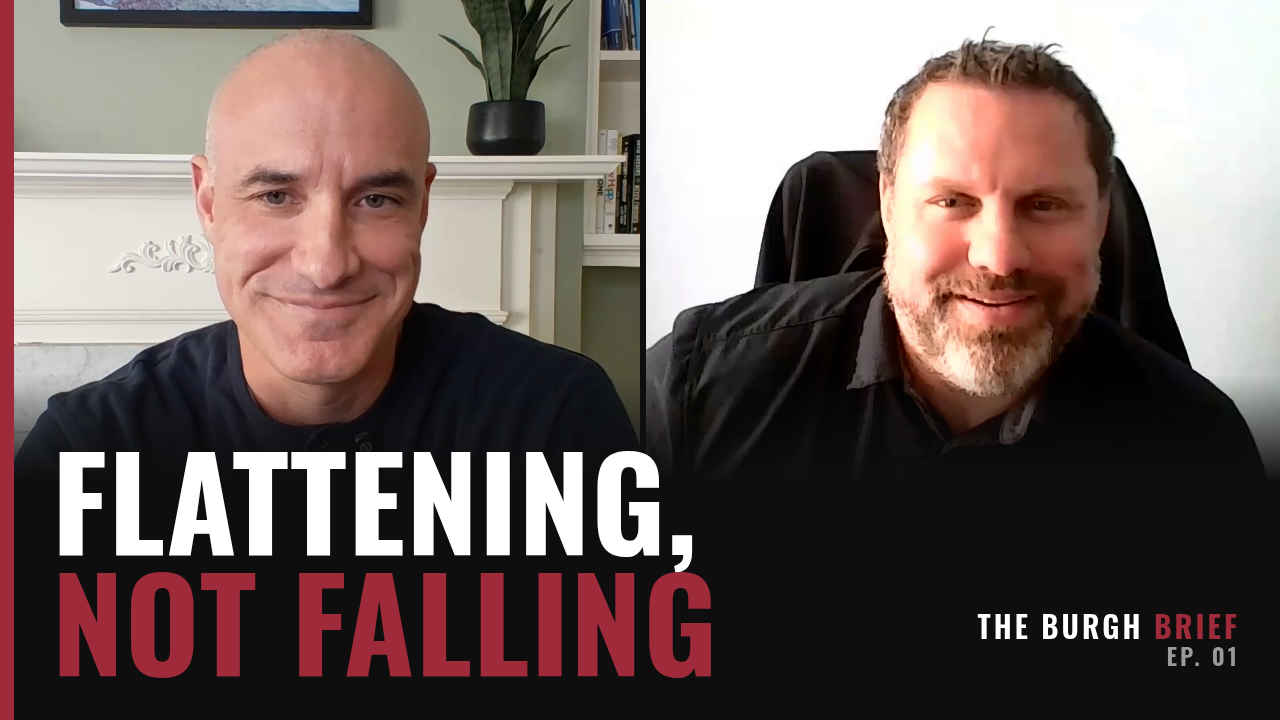
Pittsburgh Housing Market Is Flattening, Not Falling (Burgh Brief Ep 1)

Short answer: Pittsburgh's housing market is not crashing. It is flattening. Pending deals held at 557 the week of Oct 19, 2026, while 329 homes expired or were pulled off the market. Most of those homes did not sell because of price.
In episode 1 of The Burgh Brief, Matt Durbin and DJ Fairley go over the week's numbers and what sellers and buyers should do going into winter.
Watch on YouTube: https://youtu.be/yKDI77Z5310 (premieres Thursday, Oct 22, 2026 at 7:00 AM ET)
Pittsburgh numbers: week of Oct 19, 2026
From the 6-county Pittsburgh MLS Market Watch:
- Pending deals: 557 (558 the week before)
- New listings: 575 (down from 640)
- Sold: 395 (down from 424)
- Price drops: 734 (727 the week before)
- Expired or withdrawn: 329 (up from 285)
Pending held. Fewer homes came on and fewer sold. That is flattening, not falling. For the full weekly numbers, see our Pittsburgh Metro Housing Market Update - Week of October 19, 2026.
Why 329 homes didn't sell
329 homes expired or were withdrawn that week. That is 193 expired and 136 withdrawn. The main reasons:
- Price. This is the big one. Pricing high "to leave room" most often means fewer showings, not more money.
- Condition. Buyers compare your home to every other home online. Repairs and clutter cost you showings.
- Marketing. Photos and the first two weeks online matter most. That is when a home gets the most attention.
Why sold comps mislead right now
Sold comps show what buyers paid months ago. Many of those deals were signed in spring, in a different market.
- Your neighbor's spring price is not your price today.
- Look at what just went pending near you, not only what sold.
- Look at the active homes you are up against. Those are the homes buyers are touring.
Why starting high backfires
- A high price gets fewer showings in the first two weeks, when interest is highest.
- The longer a home sits, the more buyers ask what is wrong with it.
- Price cuts later often end lower than a right price from day one.
- Holding a home over winter costs money each month.
Months of inventory: look at your own area
Months of inventory tells you how long it would take to sell every home for sale at the current pace. A big metro number can hide what is going on in your area.
- Count the active homes in your price range and area.
- Count how many went pending in the last 30 days.
- If only a few will sell this month, price to be one of them.
This changes a lot by area, from Allegheny County to Washington, Butler, Beaver and Westmoreland Counties.
Peters Township: the $1M+ market
From our team's MLS pull (week of Oct 12, 2026):
- 19 homes for sale over $1 million in Peters Township
- 0 of them under contract
On the show, Matt pointed out that homes in the $400K-$600K range are still moving there. The top end is the part that has stalled.
National numbers: NAR September 2026
From NAR's September existing-home sales report (Oct 13, 2026):
- Sales pace: 3.99 million a year, up 1.5% from August
- Sales down 2.2% from a year ago
- Homes for sale: 1.60 million, up 4.6% from a year ago
- Supply: 4.8 months
- Median price: $417,500, up 1.3% from a year ago
NAR said August and September were the two slowest months for sales this year. Its chief economist said sellers "need to be realistic about local market conditions." For more on how Pittsburgh compares, see our Pittsburgh real estate market: September 2026 post.
Buyer strategies right now
- Look at homes that have been sitting. There may be room to talk price.
- Know your monthly payment before you shop.
- Stay in touch with your lender. Rates move, and your pre-approval may not match today's rate. The 30-year fixed was 7.43% on Oct 19, 2026 (Mortgage News Daily).
Buydowns and closing cost credits
- Rate buydown: money paid up front to lower your rate, for a few years or for the whole loan. Sellers can sometimes pay for it.
- Closing cost credit: the seller pays some of your closing costs, so you bring less cash to closing.
- Which one helps more depends on your loan and plans. Ask your lender to show you both.
Learn more in our post on temporary buydowns in Pittsburgh.
For illustration only. Not a loan offer or commitment to lend. Rates, payments, and terms depend on credit, income, loan program, and lender approval, and can change without notice. Buyers may need to qualify at the full note rate. Talk to a licensed lender for details.
Common questions
Is the Pittsburgh housing market crashing?
No. Pending deals held at 557 the week of Oct 19, 2026, almost the same as the week before (558). The market is flattening, not falling.
Why did 329 Pittsburgh homes not sell?
They expired or were withdrawn the week of Oct 19, 2026 (193 expired, 136 withdrawn). Price is the main reason. Condition and marketing also matter.
Should I price my home based on sold comps?
Not only sold comps. They can be months old. Look at what just went pending and the active homes you compete with.
What is happening with $1M+ homes in Peters Township?
Our MLS pull for the week of Oct 12, 2026 showed 19 homes for sale over $1 million and 0 under contract.
How does Pittsburgh compare to the national market?
NAR reported a $417,500 national median price and 4.8 months of supply for September 2026.
What is the difference between a buydown and a closing cost credit?
A buydown lowers your interest rate. A closing cost credit lowers the cash you need at closing. A licensed lender can show you which helps more.
Sources
- Pittsburgh numbers: residential MLS Market Watch for Allegheny, Westmoreland, Washington, Butler, Beaver and Fayette Counties, weeks of Oct 12 and Oct 19, 2026
- Peters Township $1M+: Matt Durbin Team MLS pull, week of Oct 12, 2026
- National numbers: NAR, "Existing-Home Sales Increased 1.5% in September," Oct 13, 2026: https://www.nar.realtor/newsroom/existing-home-sales-increased-1-5-in-september-according-to-nar-report
- Mortgage rate: Mortgage News Daily, Oct 19, 2026: https://www.mortgagenewsdaily.com/markets/mortgage-rates-10192026
Matt Durbin | eXp Realty
(412) 998-8896 | Broker: (888) 397-7352
MAD.Homes

Matt Durbin
Team Leader | Matt Durbin Team | eXp Realty
or another way