
Categories
First Time Buyers, Home Buyers, Home SellersPublished May 12, 2026
What Is My Pittsburgh Home Worth Right Now? (And Why Zillow Gets It Wrong)

What Is My Pittsburgh Home Worth Right Now? (And Why Zillow Gets It Wrong)
If you’ve ever typed your address into Zillow and watched a number pop up in seconds, you’re not alone. Most Pittsburgh homeowners do it. Some do it every few months. And almost all of them walk away with a number that is either too high, too low, or too disconnected from your actual neighborhood to mean anything.
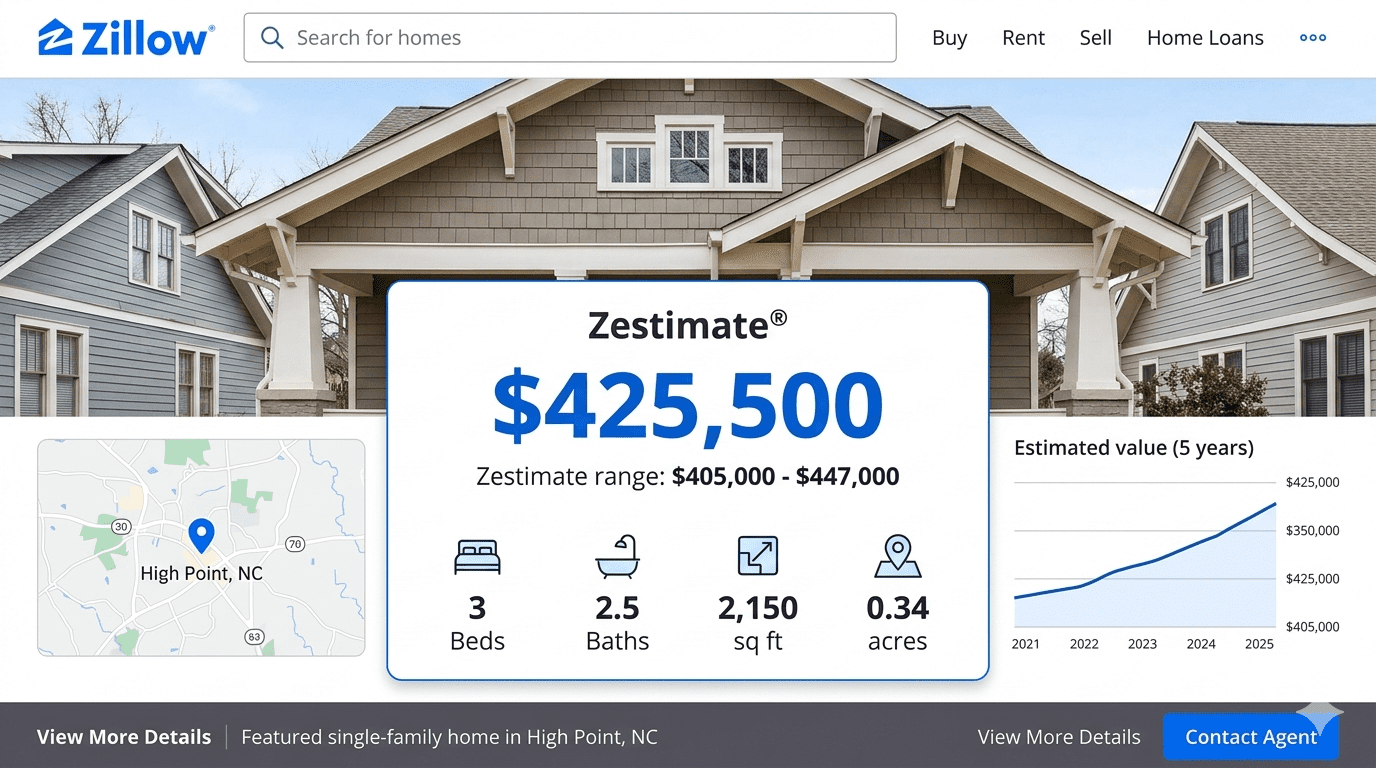
That number has a name: the Zestimate. And while it’s a useful starting point for curiosity, it is not what a buyer will pay for your home. Here’s what it actually takes to answer the question correctly.
Why Zillow’s Estimate Misses the Mark in Pittsburgh
Zillow’s algorithm is built on publicly available data: tax records, prior sale prices, and square footage. That works reasonably well in cities where homes are newer, more uniform, and change hands frequently.
Pittsburgh is none of those things.
Our housing stock is old, diverse, and deeply neighborhood-dependent. A 1,800 square foot home in Mount Lebanon sells for a completely different number than a nearly identical home in Brentwood — and both will look similar on paper. Zillow cannot see the finished basement, the updated kitchen, the new roof, or the fact that your street backs up to a park. It also cannot account for Pittsburgh’s hyperlocal micro-markets, where prices can shift meaningfully from one ZIP code to the next.
Zillow has publicly stated its Zestimate carries a median error rate. In markets like ours, with older housing stock and lower transaction volume, that error rate climbs. Being off by 5–10% on a $350,000 home means you could be mispricing by $17,500 to $35,000 — in either direction.
What Actually Determines Your Pittsburgh Home’s Value
A home is worth what a ready, willing, and qualified buyer will pay for it in the current market. That number comes from comparing your property to homes that have actually sold — not listed, not estimated, but closed — in recent months within your specific area.
The factors that move your number up or down:
- Location within your submarket. In Pittsburgh, this means the specific school district, proximity to major corridors, and how your street compares to the comps.
- Condition and updates. Buyers pay a premium for move-in ready. Updated kitchens, bathrooms, and mechanicals (roof, HVAC, electrical) compress days on market and push price up.
- Square footage and usable space. Total square footage matters, but so does how it’s laid out. A finished lower level in Pittsburgh adds real value — if it’s done correctly.
- Current inventory levels. Right now, Pittsburgh is one of the most supply-constrained markets in the country. Low inventory puts upward pressure on prices — but that advantage disappears quickly if you’re overpriced at launch.
- Recent comparable sales within the last 90 days. Markets shift. A sale from eight months ago may no longer reflect what buyers are doing today.
What Is a Comparative Market Analysis (CMA)?
A Comparative Market Analysis — or CMA — is how real estate professionals determine a home’s market value before listing. It is not a guess and it is not an algorithm.
A proper CMA pulls actual closed sales from the MLS within a relevant radius, filters for homes that match yours in size, age, condition, and style, and then makes manual adjustments for the differences. It also looks at active listings (your competition) and expired listings (what buyers rejected).
Done correctly, a CMA gives you a defensible price range — not just a number to feel good about, but a range you can explain to a buyer’s agent and an appraiser.
What the Pittsburgh Market Looks Like Right Now
Pittsburgh has outperformed most major U.S. metros on price stability because our market never experienced the same speculative run-up that other cities did. That means we also haven’t experienced the same correction.
What that means for sellers in 2025:
- Inventory remains tight across most Pittsburgh submarkets, which gives well-priced homes significant negotiating leverage.
- Buyers are active but rate-sensitive. The pool is serious — these are not casual shoppers. But they are paying attention to monthly payments, and overpriced homes stall.
- South Hills, Washington County, and Peters Township continue to see strong demand from buyers relocating from higher-cost metros, particularly for move-in ready homes priced competitively.
- Homes that are overpriced at launch sit. Days on market accumulate fast, and buyers start asking what’s wrong with it.
The Real Cost of Getting Your Price Wrong
Overpricing is the most expensive mistake a Pittsburgh seller can make — and it’s far more common than underpricing.
Here’s what typically happens: A seller trusts the Zestimate or anchors to what a neighbor got two years ago. The home goes on the market at the wrong number. Showings slow after the first week. Days on market climb past 30, then 45. The listing gets stale. Buyers wonder if something is wrong. Then comes the price reduction — and the home sells for less than it would have if it had been priced correctly from day one.
The first two weeks on the market are your most powerful window. You do not get that back.
How to Get a Real Answer on Your Home’s Value
There are three ways to find out what your Pittsburgh home is actually worth:
- Request a professional CMA from a local agent. This is free, and a good agent will walk you through the comps, explain the adjustments, and give you a range you can actually defend. This is the most accurate option short of an appraisal.
- Get a formal appraisal. A licensed appraiser will produce a certified value that is typically used for financing. This costs $400–$600 and is most useful if you have an unusual property or need documentation for a specific purpose.
- Use automated tools as a starting point, not a finish line. Zillow, Redfin, and similar tools can tell you if your home is in the ballpark. They cannot tell you what a buyer will pay for yours specifically.
Want to Know What Your Home Is Actually Worth?
The Matt Durbin Team has been the #1 eXp Realty team in Pennsylvania for six years running. We do more transactions in the Pittsburgh market than almost anyone — which means we see what homes actually sell for, not what they list for.
If you want a straight answer on what your Pittsburgh home is worth right now, we’ll pull the comps, walk through the data with you, and give you a real number — no pressure, no obligation.
Reach out to schedule a no-obligation home valuation.
Contact the Matt Durbin Team: 412.396.9800 | exppgh.com
https://www.mad.homes/home_value

Matt Durbin
Team Leader | Matt Durbin Team | eXp Realty
or another way